A brand development strategy is the structured plan a business follows to build, define, and grow its brand over time. It covers who the brand is for, what it stands for, how it communicates, how it looks, and how all of that evolves as the business grows. Without one, branding decisions get made reactively, inconsistently, and usually in the wrong order.
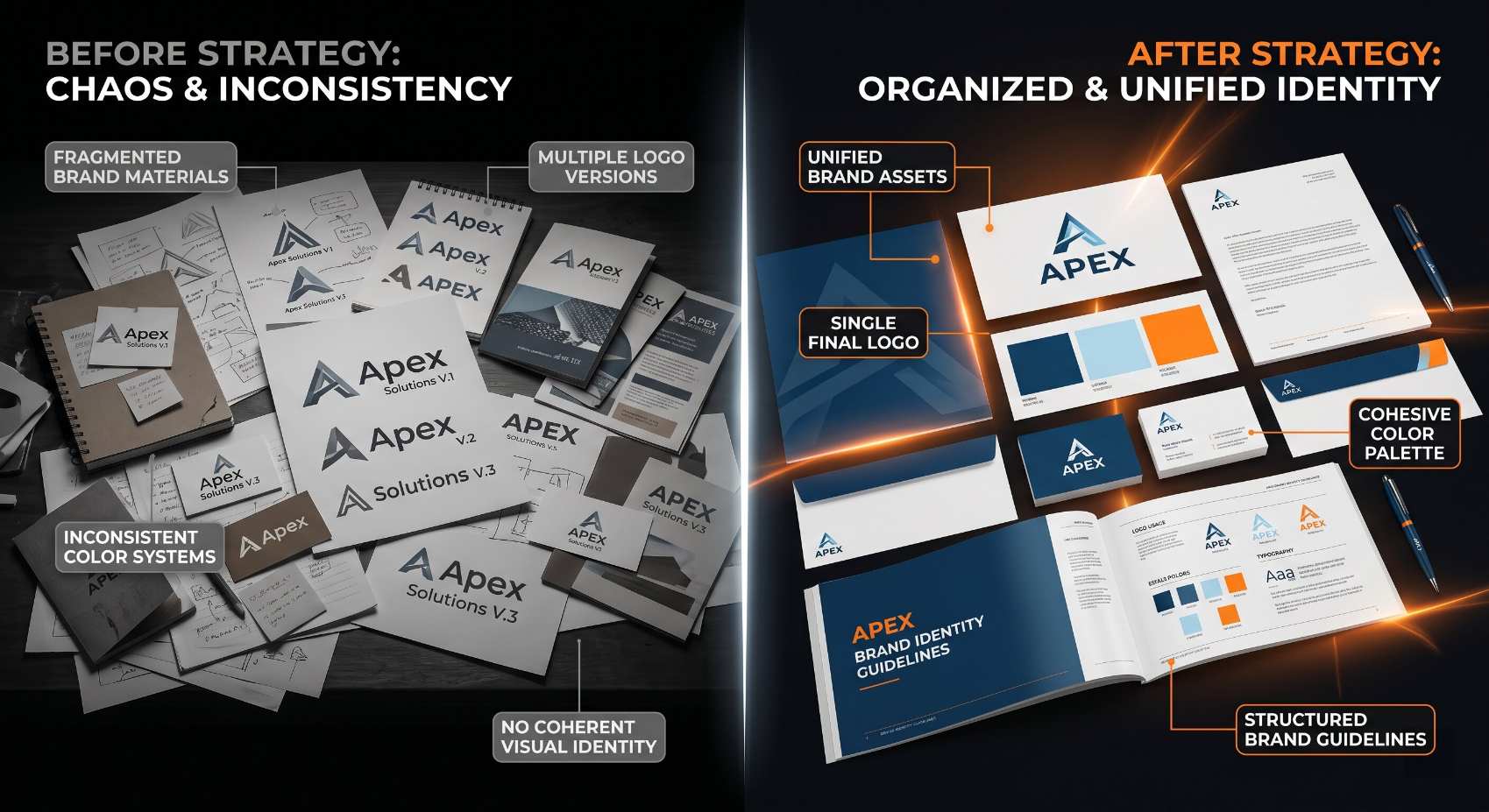
Most businesses treat branding as a series of one-off projects: hire someone to make a logo, build a website, create some social media templates. Each piece gets done in isolation, often by different people at different times, with no shared strategic foundation underneath. The result is a brand that looks scattered, communicates inconsistently, and struggles to build the recognition that drives growth.
A brand development strategy replaces that reactive approach with a deliberate one. It establishes the foundation first, then builds every expression of the brand on top of it. This is the work at the core of our brand strategy services, and it applies equally to businesses building a brand from scratch and those rebuilding one that has outgrown its original form.
A brand development strategy is the long-term plan that defines what a brand stands for, who it serves, how it is positioned in the market, and how it expresses itself consistently across every touchpoint from visual identity to tone of voice.
Brand Development Strategy vs Brand Strategy: What Is the Difference?
The two terms are closely related and often used interchangeably, but they are not identical.
Brand strategy is the strategic foundation itself: the positioning, the audience definition, the value proposition, and the core differentiation. It answers the question of who the brand is and why it exists in the market.
Brand development strategy is broader. It includes the brand strategy foundation but also covers the process of building and growing the brand over time. It addresses not just what the brand is, but how it gets built, how it evolves through growth stages, and how it is managed as a long-term asset.
| Brand Strategy | Brand Development Strategy | |
|---|---|---|
| Focus | Defines what the brand is and where it stands | Defines what the brand is and how it gets built over time |
| Time horizon | Stable, long-term reference point | Ongoing, evolves with the business |
| Key outputs | Positioning, messaging, differentiation | Positioning plus identity system, growth plan, brand architecture |
| Primary question | Who are we and why should anyone care? | Who are we, how do we build that, and how do we grow it? |
| Used by | Founders, strategists, brand directors | All of the above, plus design teams, marketing teams, product teams |
Think of brand strategy as the brief and brand development strategy as the full plan that executes and grows from that brief.
The Core Components of a Brand Development Strategy
A complete brand development strategy covers several interconnected layers. Each one builds on the one before it. Skipping layers or building them out of sequence is the most common reason brand development work needs to be redone.
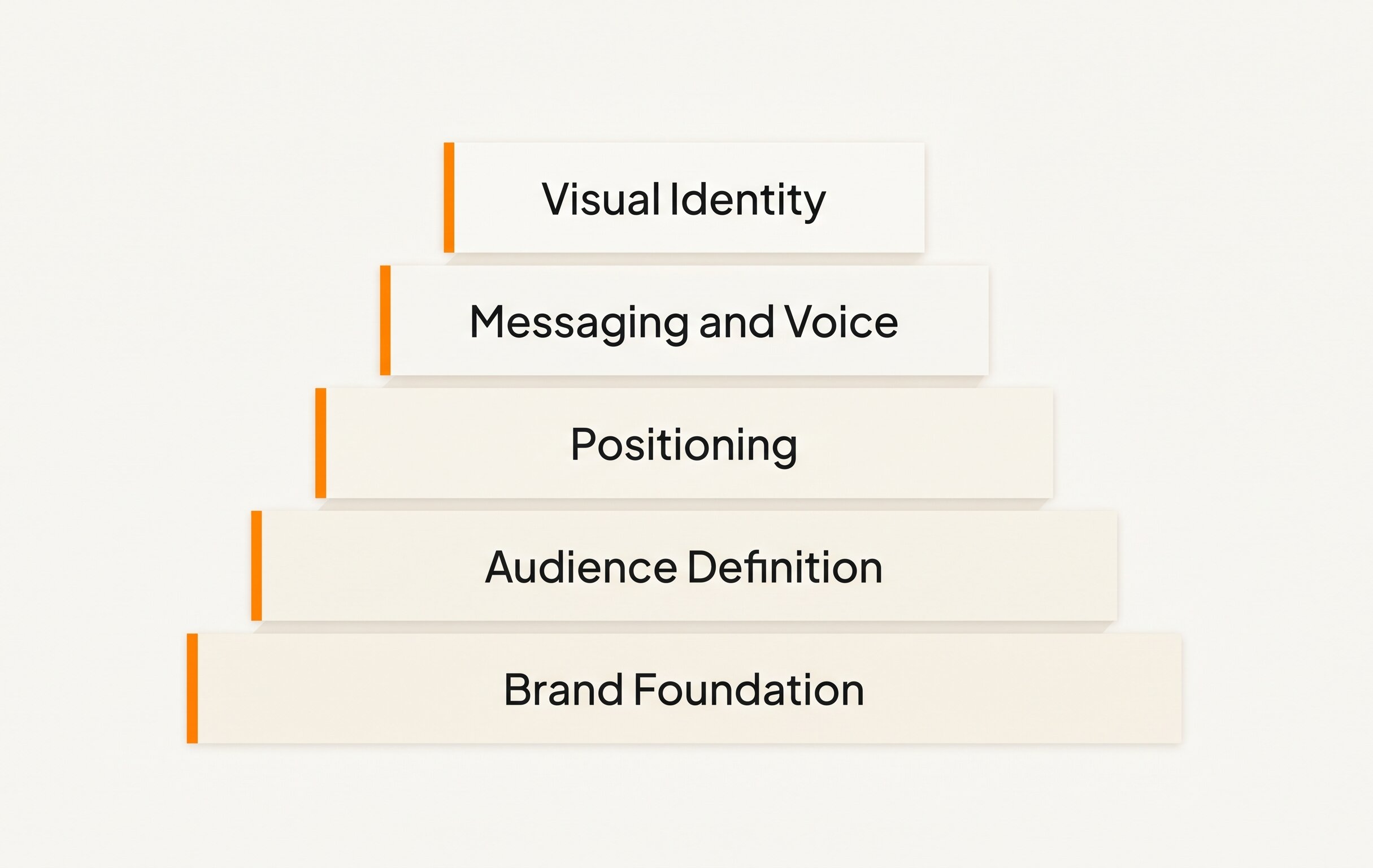
Each layer of a brand development strategy builds on the one below it. Building out of sequence produces a brand that lacks cohesion.
-
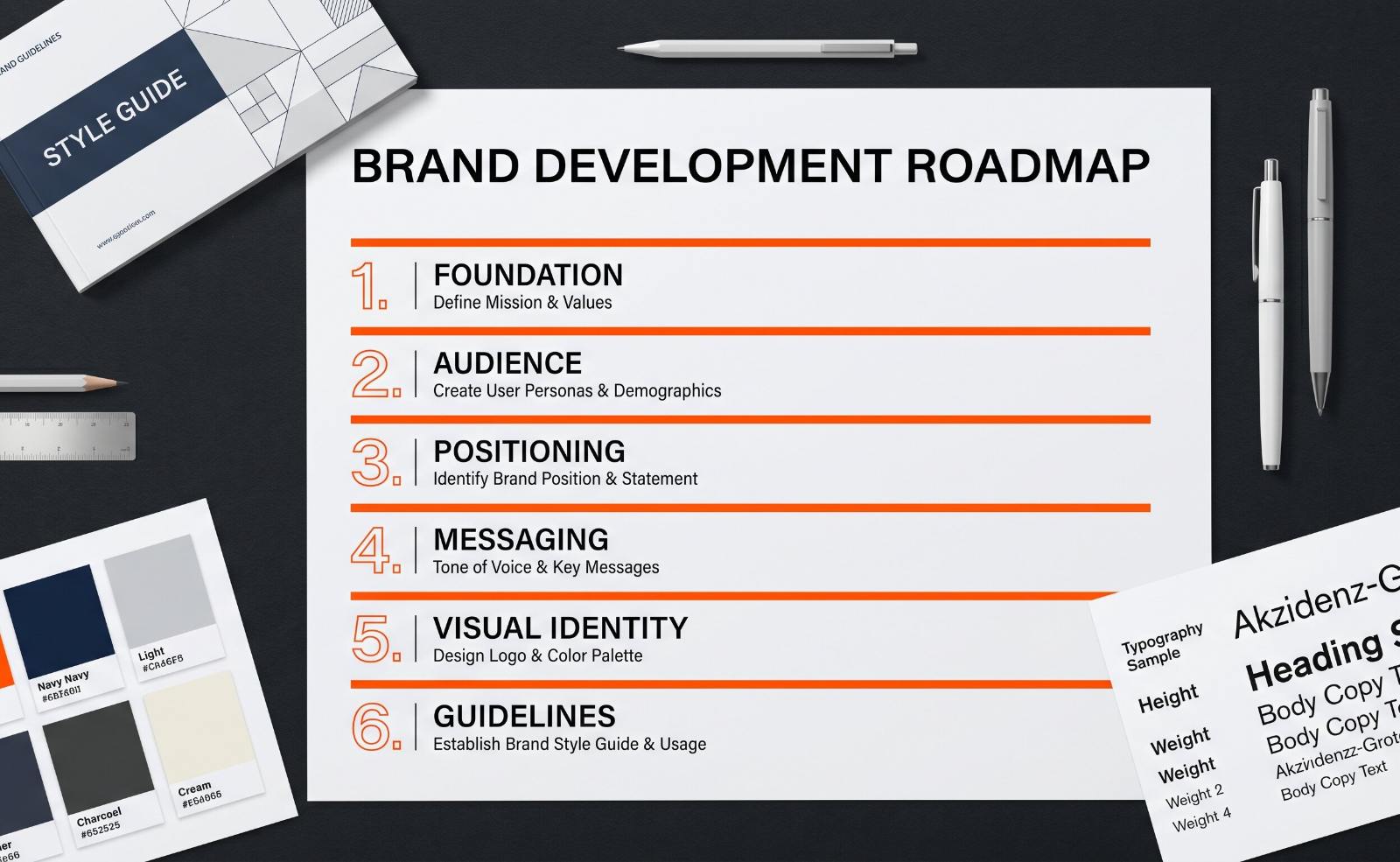
01
Brand Foundation: Purpose, Vision, and Values
Every brand development strategy starts with the foundation: why the business exists beyond generating revenue, what it is trying to build or change, and the values that govern how it operates. These are not marketing statements. They are internal anchors that every brand decision should be traceable back to.
A clear brand purpose keeps the business coherent as it grows. It prevents the drift that happens when teams make disconnected decisions without a shared reference point. It also gives the brand something genuine to communicate, which is what creates long-term trust with audiences rather than just transactional awareness.
-
02
Audience Definition
A brand without a clearly defined audience is a brand trying to be everything to everyone, which means it resonates with no one at the level required to build loyalty. Audience definition in brand development goes further than demographic data. It covers the specific problems your audience is trying to solve, how they currently evaluate options in your category, what language they use to describe their situation, and what they are most sceptical about when considering a business like yours.
This level of audience understanding is what makes positioning specific enough to be useful. Vague audience definitions produce vague positioning. Specific audience understanding produces specific, compelling differentiation. Our work in brand positioning is built entirely around this specificity.
-
03
Brand Positioning
Brand positioning defines the specific place your brand occupies in the mind of your target audience relative to alternatives. It answers: among all the options available to my audience, what do I offer that no one else does, and why does that matter to the people I am trying to reach?
Strong positioning is specific, credible, and ownable. It rules things out, which makes it uncomfortable to write but effective in practice. A positioning statement that could apply to any business in your category has no value. One that is specific enough that competitors could not honestly make the same claim is the goal.
Positioning is the single most important output in the entire brand development process. Every other component, messaging, identity, voice, takes its direction from the positioning. If the positioning is weak, nothing built on top of it will be strong.
-
04
Brand Messaging and Voice
With positioning defined, the next layer is translating it into the language the brand uses consistently across every communication. This includes the core value proposition (the primary benefit you offer, stated clearly), supporting messages for different audience segments or contexts, and the brand voice, the consistent personality and tone that comes through whether you are writing a website headline or a client email.
Brand voice is what makes a brand sound like itself across every format and every person on the team who creates content for it. Without documented voice guidelines, brand communications drift as soon as more than one person is involved in producing them. Our brand messaging services cover this layer specifically, building the messaging architecture that keeps communications coherent at scale.
-
05
Visual Identity System
The visual identity is the most visible output of the brand development process, but it is built last for a reason. Every visual decision should be a direct expression of the positioning and messaging established in the layers above. The logo, color palette, typography system, and visual language are the translation of strategy into something people can see and recognize.
A visual identity that was designed without a strategic foundation may look strong in isolation but will consistently underperform in the market because it has no specific meaning to communicate. It looks like something, but it does not say anything. Strong brand identity design is built on strategic clarity, not aesthetic preference.
-
06
Brand Guidelines and Consistency Systems
The final component of the initial brand development phase is documentation. Brand guidelines capture all of the decisions made across the previous five layers in a form that can be shared with anyone who creates communications for the brand: internal team members, external agencies, freelancers, and partners.
Guidelines should be specific enough to prevent common mistakes and practical enough to actually be used. The most common failure at this stage is producing a document so dense or theoretical that no one references it in day-to-day work. Good brand guidelines are built for the people who will use them, not for the people who created the brand.
Brand Development at Different Business Stages
The depth and focus of a brand development strategy changes depending on where the business is in its growth.
Early-Stage Business
- Priority is getting the positioning right before spending on marketing
- Even a lean brand foundation outperforms no foundation significantly
- Focus on: positioning, audience definition, core messaging, basic visual identity
- Avoid: over-investing in visual complexity before the strategy is clear
- Risk of skipping: inconsistent early communications that are expensive to fix later
Growth-Stage Business
- Brand has likely outgrown its original identity and needs strategic realignment
- Priority is closing the gap between what the business has become and how it presents
- Focus on: repositioning, refined messaging, stronger identity system, brand architecture
- Avoid: treating the rebrand as purely visual when the strategy needs updating too
- Risk of skipping: marketing spend that fails to compound into lasting recognition
Growth-stage businesses that have not revisited their brand development strategy since founding are particularly common. The brand they launched with was built for a company that no longer exists. The positioning, the audience, and often the visual identity were appropriate for where they started, not where they are now. This is typically the trigger for a full corporate rebranding process.
What a Brand Development Strategy Is Not
It helps to be specific about what falls outside brand development strategy, because these things are commonly confused with it.
- It is not a marketing plan. Marketing strategy executes on top of brand strategy. Brand development defines what the marketing is communicating and who it is reaching. The two are connected but operate at different levels and should not be built simultaneously.
- It is not a logo or visual refresh. Updating your visual identity without the strategic work underneath it is the most common and most expensive branding mistake. Visuals that are not rooted in positioning and audience understanding look polished but do not communicate anything specific.
- It is not a one-time project. Brand development is an ongoing discipline. The core positioning may remain stable for years, but how the brand expresses itself, what audiences it prioritizes, and how it is structured as the business adds services or enters new markets all require active management.
- It is not just for large companies. The belief that brand development strategy is only relevant for enterprise businesses is one of the most consistently expensive myths in business. A clear brand strategy produces a measurable return for businesses of any size by making every marketing effort more efficient and every client interaction more coherent.
The businesses that skip brand development strategy do not avoid the cost. They pay it later, in the form of scattered marketing spend, inconsistent client experiences, and rebranding work that could have been avoided with the right foundation from the start.
How to Know If Your Business Needs Brand Development Work
The following are reliable indicators that a brand development strategy is either missing or has become outdated:
- Your team describes the business differently depending on who is speaking
- New marketing campaigns require building messaging from scratch rather than pulling from a shared framework
- Your visual identity looks different across your website, proposals, social media, and printed materials
- Clients remember your work but struggle to describe your brand specifically
- You are winning business despite your brand rather than because of it
- The business has grown or changed significantly since the original brand was created
- You are spending on marketing but not seeing the results compound into lasting recognition
Any of these on their own is worth taking seriously. Several together usually means the brand foundation needs rebuilding before more marketing investment makes sense. See how we have approached this kind of foundational work across our client case studies.
Frequently Asked Questions
A focused brand strategy engagement for a growing business typically takes 2 to 4 weeks. A comprehensive brand development process covering strategy, full visual identity, brand guidelines, and rollout support takes 8 to 12 weeks for most businesses.
The timeline is most significantly affected by how clearly the business can articulate its current positioning and audience, and how many stakeholders need to be involved in approvals. Businesses with clear founders who can make decisions quickly move through the process faster than those with multiple decision-makers requiring alignment at each stage.
Build the brand foundation your business actually needs.
We help growing businesses develop brand strategies that are specific, ownable, and built to last — from positioning and messaging through to a complete visual identity system.