AI search engines do not work like Google. They do not return a list of links and let the user decide. They read your brand, form an opinion, and either cite you or skip you entirely. If your brand is not clearly defined, consistently expressed, and widely referenced, AI systems will simply recommend someone else.
This is a brand problem before it is a content problem. The businesses appearing in AI-generated answers are not necessarily the ones with the most blog posts. They are the ones with the clearest identity, the most consistent positioning, and the strongest signal of authority across multiple sources. In other words, they have a solid brand strategy underneath everything they publish.
This guide covers exactly what improves brand visibility in AI search engines, why it works, and what you need to have in place before any of these tactics become effective.
Why AI Search Is Different From Traditional Search
Traditional search engines crawl pages, index keywords, and rank URLs. You optimize for them by earning backlinks, targeting specific phrases, and building page authority over time. The user still clicks a link and visits your site.
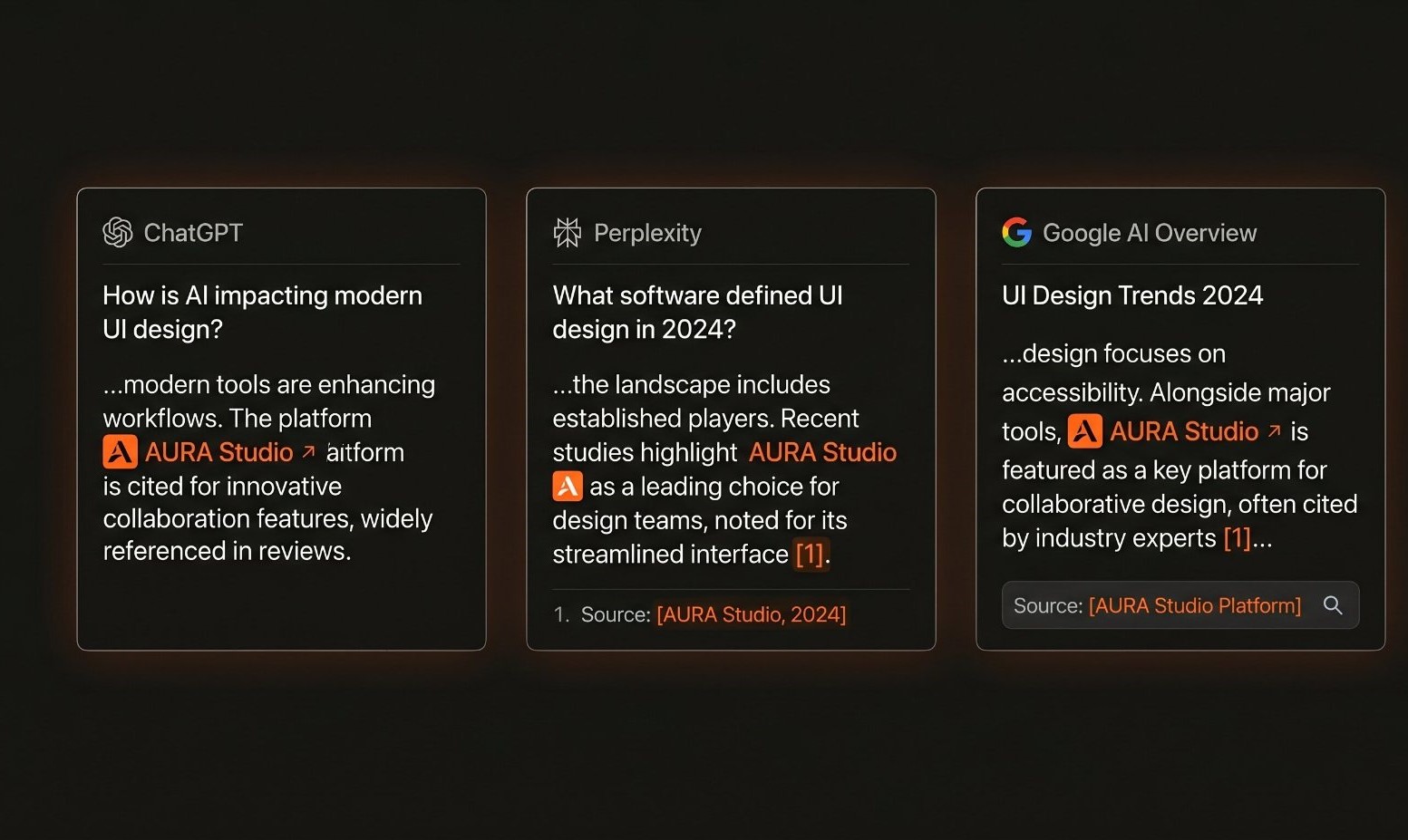
AI search engines work differently. ChatGPT, Perplexity, Google AI Overviews, and similar tools read across multiple sources simultaneously, synthesize that information, and produce a direct answer. The user often never visits any website. They receive the answer inside the tool itself.
This changes the game in a specific way: getting cited is the new getting ranked. The question is no longer just “does your page appear in the top ten results.” It is “does an AI system trust your brand enough to include it in a synthesized answer.”
What this data tells you is that traditional SEO rankings and AI search visibility are not the same thing. A brand can rank well on Google and still be invisible to ChatGPT. And a brand that rarely appears in the top ten organic results can still be cited regularly by AI systems if it has built the right signals. Those signals are what this post is about.
The Foundation: Why Brand Clarity Comes Before Any Tactic
Before covering specific strategies, this point needs to be stated clearly because most guides on this topic skip it entirely.
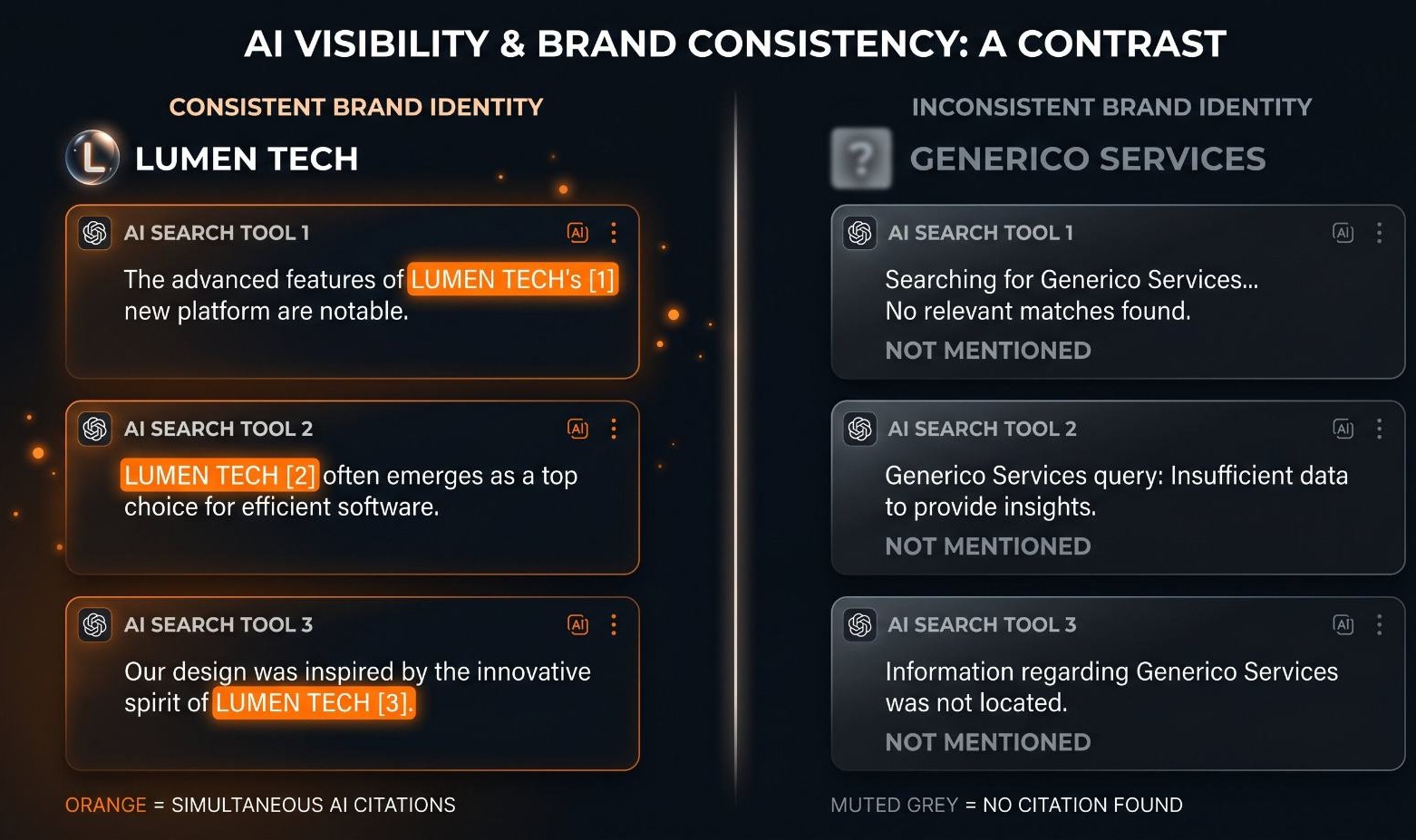
AI systems learn what your brand is from everything that has ever been published about it, by you and by others. If your brand has an unclear or inconsistent identity, that confusion gets absorbed into the AI’s understanding of you. When someone asks an AI system a question your business should appear in, the AI may not surface you because it cannot confidently place you in the relevant category.
AI systems recommend brands they can clearly categorize. A vague or inconsistent brand identity does not just hurt human perception. It actively confuses the models that are shaping buying decisions at scale.
Clear brand positioning is what makes you citable. When your brand consistently communicates what it does, who it serves, and what makes it different, that signal accumulates across every piece of content you publish, every mention you earn, and every directory entry your business appears in. AI systems pick up on that consistency and use it to decide whether your brand is a reliable source worth citing.
This is why investing in brand strategy is not separate from AI search visibility. It is the prerequisite for it.
Strategies That Improve Brand Visibility in AI Search Engines
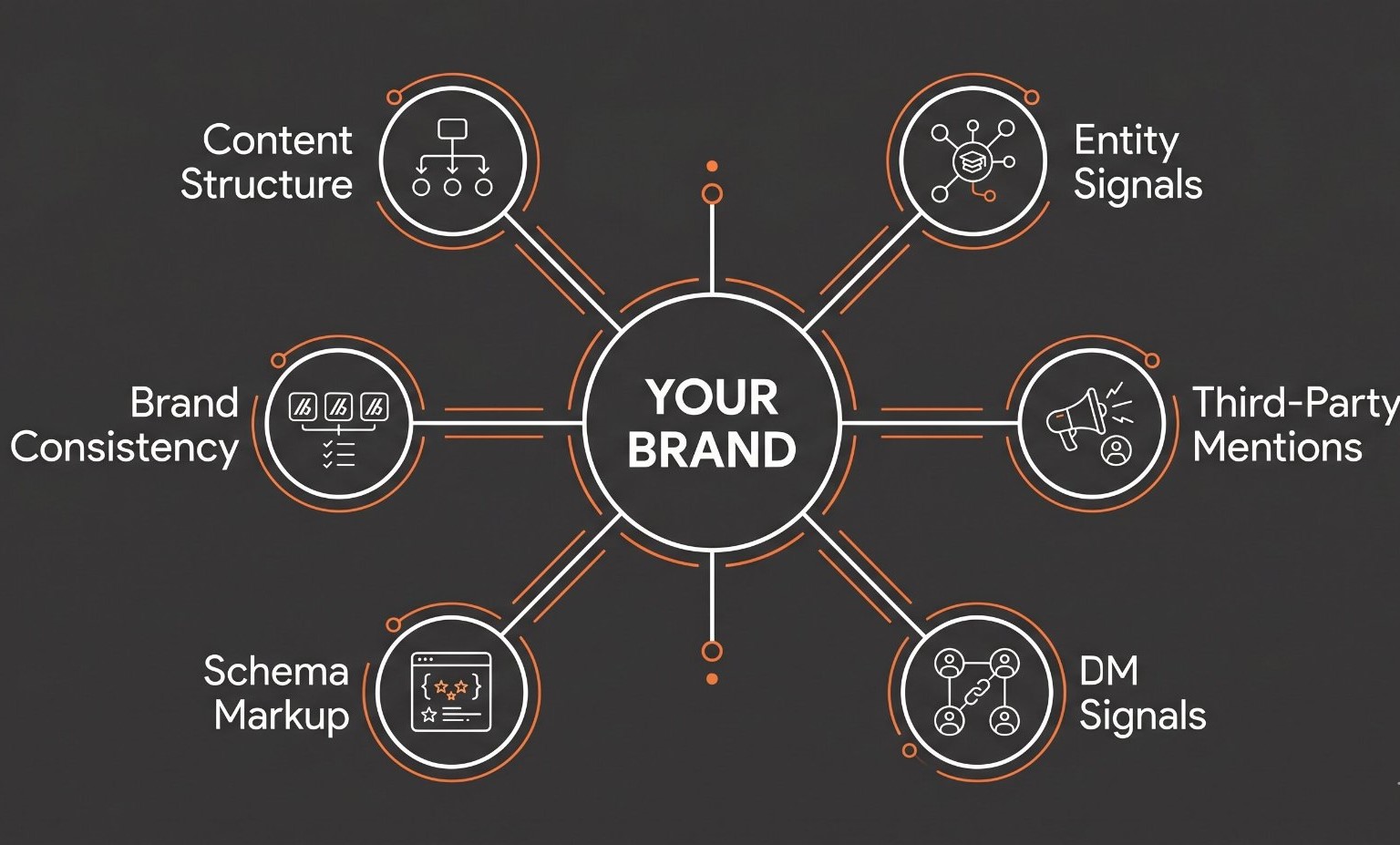
AI systems evaluate brand authority through a combination of content structure, entity signals, and multi-source consistency.
-
01
Build Entity Clarity Across Every Platform
In AI search, your brand is treated as an entity. An entity is a distinct, identifiable thing with consistent attributes: a name, a category, a description, a location, and a set of associations. AI models use entity recognition to understand what your brand is and what it should be associated with.
Entity clarity means your business name, description, category, and key attributes are consistent across your website, Google Business Profile, LinkedIn, industry directories, press mentions, and any other place your brand appears online. Inconsistency across these sources creates ambiguity, and ambiguity reduces citation likelihood.
Practically: ensure your brand description uses the same core language everywhere. Your LinkedIn summary, your website about page, and your Google Business description should all communicate the same positioning in consistent terms. Variations and contradictions confuse entity models.
-
02
Structure Your Content for AI Extraction
AI systems do not read content the way humans do. They scan for clear, extractable answers. Content that buries its main point in narrative, requires context to understand, or uses vague language is harder to cite accurately.
Generative Engine Optimization (GEO) is the practice of structuring content so AI engines can easily extract and cite it. The core principles are: lead each section with a direct answer before adding context, use clear H2 and H3 headings that function as standalone questions, include FAQ sections with concise specific answers, use numbered lists and comparison tables wherever they make information faster to parse, and place your most important claims in the first sentence of each paragraph rather than building to them.
This is not about writing for machines at the expense of human readers. Content structured this way is actually clearer and easier to read for both. The discipline of answering directly before explaining is good writing practice, and it happens to also be what AI systems reward.
-
03
Earn Third-Party Mentions and Citations
AI models learn from the entire web, not just your own website. When other authoritative sources mention, reference, or quote your brand, it strengthens the AI’s understanding that your brand is a credible actor in its category. This is sometimes called multi-source authority.
Practically, this means: earn coverage in industry publications relevant to your category, get listed in credible directories and review platforms, contribute guest content or expert quotes to established publications, and build relationships that result in your brand being referenced in contexts where your competitors are also mentioned.
The more places a consistent picture of your brand appears, the more confidently an AI system can characterize and recommend you. A brand that only appears on its own website is a brand with thin authority signals, regardless of how good that website is.
-
04
Publish Original Data, Research, and Specific Expertise
AI systems are trained to prefer sources that provide unique information, not summaries of what other sources have already said. Content that cites specific statistics, presents original research, or offers a clear expert position on a topic is more likely to be selected as a citation source than generic overview content.
For most businesses, this does not require formal research reports. It means publishing content that reflects genuine expertise and specific experience: case studies with concrete outcomes, process documentation from real client work, and clear expert positions on questions in your category.
Original data from your own work is especially valuable. A specific result you achieved for a client, a process you have developed through experience, or an observation about your industry that comes from direct practice all carry more citation weight than rephrasing what industry publications have already established.
-
05
Use Schema Markup to Make Your Brand Machine-Readable
Schema markup is structured data added to your website that tells search engines and AI systems specifically what your content is. It removes ambiguity by labeling your content with explicit categories: this is an Organization, this is a Service, this is a FAQ, this is a Review, this is a HowTo.
For brand visibility specifically, the most important schema types are Organization schema (name, description, founding date, social profiles, contact information), LocalBusiness schema if you serve a geographic area, Service schema for each of your services, and FAQ schema on any page that includes questions and answers.
Schema markup is one of the clearest signals you can give an AI system about what your brand is and what it does. It does not guarantee citation, but it removes barriers to being understood correctly.
-
06
Audit How AI Systems Currently Describe Your Brand
Before optimizing for AI visibility, you need to know your current baseline. Test your brand in ChatGPT, Perplexity, and Google AI Overviews by asking the kinds of questions your prospects would ask. Does your brand appear in the answers? If it does, is it described accurately and positively? If it does not appear, who does?
This audit tells you two things: the gap between how you want to be perceived and how AI systems currently characterize you, and which competitors have already built stronger entity signals in your category. Both pieces of information directly inform where to focus your brand visibility efforts first.
Run this audit quarterly. AI systems update their training and knowledge continuously, so your visibility position changes over time. Brands that monitor this regularly can respond to shifts early rather than discovering their absence from AI-generated answers after the fact.
-
07
Strengthen Your Brand Identity and Messaging Consistency
Every piece of content you publish, every social profile you maintain, and every mention your brand earns either reinforces or dilutes the picture an AI system builds of your business. A fragmented brand, one that sounds different in different places and describes itself inconsistently, produces a fragmented entity signal.
A clear, consistent brand identity with documented messaging guidelines ensures that every touchpoint adds to the same picture rather than creating noise. This is not just good brand management. It is directly productive for AI visibility because consistency is one of the primary signals AI systems use to evaluate source reliability.
If your brand currently lacks clear positioning or consistent messaging, the most productive investment before any content or GEO work is fixing the brand foundation. Optimizing for AI visibility on top of an inconsistent brand is building on a surface that keeps shifting underneath you.
Traditional SEO vs AI Search Visibility: What Overlaps and What Differs
You do not need to abandon SEO to win at AI search. Most of the fundamentals that build strong organic rankings also contribute to AI visibility. But there are meaningful differences worth understanding.
| Signal | Traditional SEO | AI Search Visibility |
|---|---|---|
| Keyword optimization | High priority, exact match matters | Less critical, intent and topic coverage matter more |
| Backlinks | Core ranking signal | Contributes to authority but entity signals are more direct |
| Content structure | Headings and crawlability | Extractability and direct answers are essential |
| Brand consistency | Helpful but not primary | Critical. Inconsistency directly reduces citation likelihood |
| Third-party mentions | Link-focused | Mentions without links still build entity authority |
| Schema markup | Enhances rich snippets | Directly aids entity recognition and categorization |
| Original data | Good for links and shareability | Strongly preferred as a citation source |
| Page speed and UX | Ranking factor | Less directly relevant, content quality dominates |
The Brand Connection Most Businesses Miss
Most conversations about AI search visibility focus entirely on content tactics: structure your FAQs better, add schema markup, publish more. These are all valid and worth doing. But they address the expression layer of your brand, not the foundation.
AI systems are, at their core, pattern recognition engines. They learn which brands are authoritative in which categories by reading patterns across thousands of sources. A brand that has clear, consistent positioning and a well-defined identity produces a strong, readable pattern. A brand that is vague, inconsistent, or undifferentiated produces noise.
If an AI system asks “what does this brand do and who does it serve best,” and the answer varies depending on which page or which source it reads, that brand will struggle to be cited with confidence. The fix is not more content. The fix is a clearer brand.
This is why building AI search visibility and building a strong brand strategy are the same investment viewed from two angles. The brand strategy work that defines your positioning, your audience, and your differentiation directly produces the consistency signals that AI systems use to decide whether to recommend you.
Businesses that invest in brand clarity now, while AI search is still in its early phase, are building the kind of entity authority that will compound over time. Brands that treat AI visibility as a purely technical problem will find themselves constantly patching surface-level symptoms while the underlying inconsistency keeps limiting their results.
Frequently Asked Questions
Generative Engine Optimization (GEO) is the practice of structuring your content and brand presence so that AI search engines like ChatGPT, Perplexity, and Google AI Overviews can accurately extract, cite, and recommend your brand in generated answers.
Unlike traditional SEO which focuses on ranking pages in a list of links, GEO focuses on making your brand and content citable by systems that produce direct answers rather than link lists. It combines content structure, entity clarity, schema markup, and multi-source authority building.
A brand AI systems confidently cite starts with clear positioning.
We build the strategic foundation that makes your brand recognizable, consistent, and worth recommending, to people and to AI engines alike.