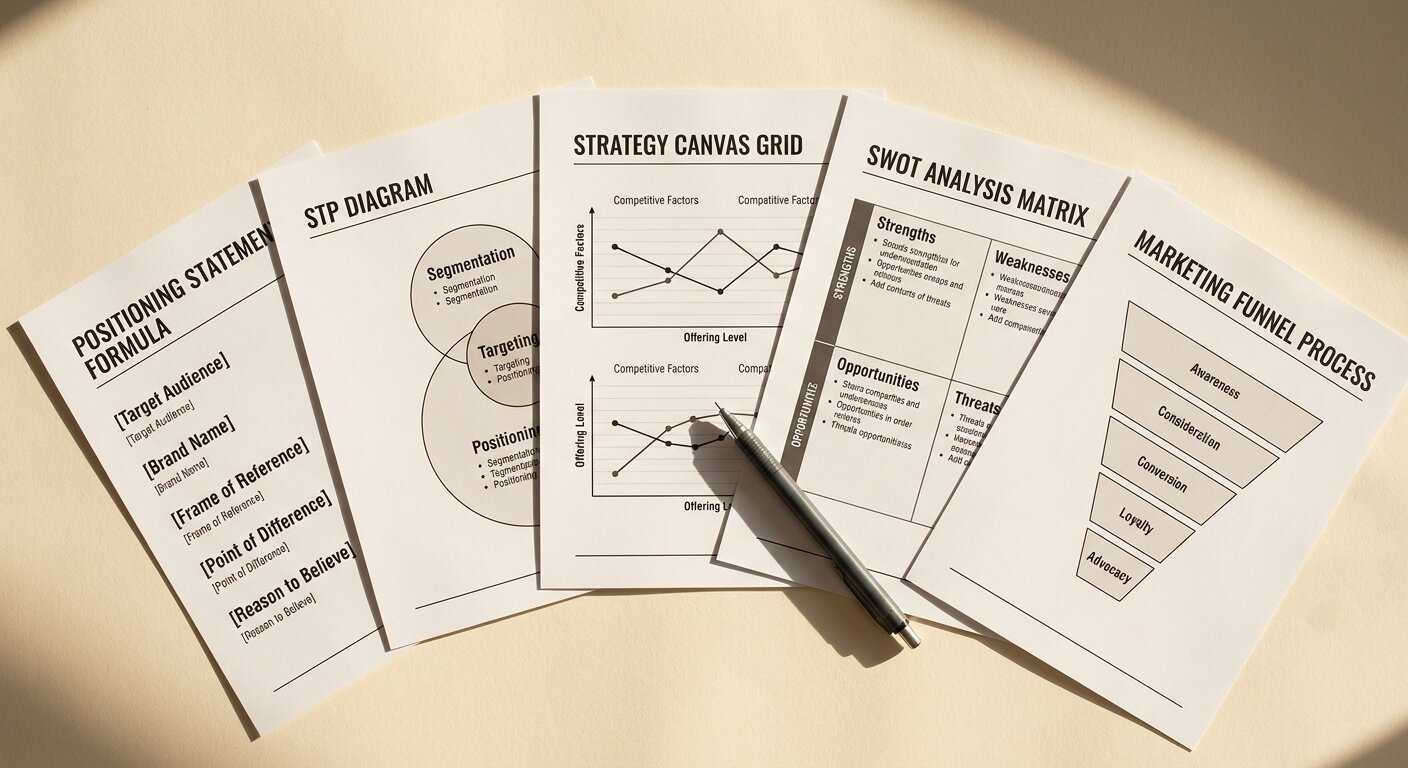
A positioning framework is the structure that turns vague brand intent into a clear, defensible market position. Without one, positioning conversations go in circles: teams debate taglines, disagree on target audiences, and produce documents that nobody uses. With the right framework, the same conversation produces a specific, evidence-backed position that every team member understands and every design and marketing decision can be tested against.
This guide covers the five most effective brand positioning frameworks, how each one works, when to use it, and real-world examples of businesses that have applied each approach well. It also covers how to choose between them and how to sequence them when more than one is needed.
If you are new to positioning and want to understand what it is before diving into frameworks, the post on what brand positioning means in a marketing context covers the foundational concepts. If you already understand positioning and are ready to choose a method, start here.
What a Brand Positioning Framework Actually Does
A positioning framework is not a creative exercise. It is a structured decision-making process that forces clarity on four questions every brand must answer:
- Who exactly is this brand for?
- What specific problem does it solve better than every alternative?
- What is its proof that this claim is true?
- Where does it sit in the competitive landscape relative to everything else the target customer might consider?
Different frameworks approach these questions in different orders and with different emphasis. Some start with the customer. Some start with the competition. Some start with the category. The right framework for your business depends on where your current positioning problem is most acute.
The best positioning framework is the one that forces your team to make a decision, not the one that lets you document every option without committing to any of them.
The Five Core Brand Positioning Frameworks
The Classic Positioning Statement
Developed from the foundational positioning work of Al Ries and Jack Trout and refined through decades of brand strategy practice, the classic positioning statement is the most widely used framework because it forces the most important commitment: putting your audience, your differentiation, and your proof into a single articulation that either holds together or falls apart.
The formula is structured and deliberate. Every blank must be filled with something specific. Vague answers reveal vague positioning, which is precisely why this framework is valuable even for businesses that have been operating for years.
This statement is an internal document. It is not a tagline and it is not meant to be published. Its purpose is to keep every person working on the brand aligned on the same strategic foundation. When a new campaign is proposed, the positioning statement is the filter: does this reflect what we said we stand for?
The most common failure with this framework is filling in the blanks with broad, generic language. “Businesses of all sizes” is not a target audience. “High quality and great service” is not a differentiator. The framework only works when every field is answered with uncomfortable specificity.
The STP Framework: Segmentation, Targeting, Positioning
Where the classic positioning statement starts with a blank and asks you to fill it in, the STP framework starts with the market and works inward. It is a three-phase process: first you divide the market into distinct segments, then you evaluate those segments to select the ones most worth pursuing, then you define the specific position your brand will occupy for the chosen segment.
STP is particularly useful when a business serves or could serve multiple audience types but needs to make a deliberate choice about where to concentrate. It prevents the common mistake of trying to position a brand for everyone by forcing an explicit targeting decision before any positioning work begins.
Target: Evaluate each segment on size, growth, competition, and fit with your capabilities. Choose one or two primary segments.
Position: Define the specific value your brand delivers to the chosen segment, and how it differs from every alternative that segment is already aware of.
The segmentation phase is where most businesses underinvest. Segments are often defined by basic demographics (age, industry, company size) when the more useful variables are behavioural and attitudinal. How does the customer currently solve this problem? What do they believe about the category? What has frustrated them about existing alternatives? These variables produce segments that are genuinely different in what they need from a brand, not just in what they look like.
Jobs to Be Done Positioning
Jobs to Be Done (JTBD) was developed by Clayton Christensen and has since become one of the most influential frameworks in brand and product strategy. The core insight is that customers do not buy products or services. They hire them to do a specific job in their lives or businesses. Understanding that job, and the circumstances in which someone decides to hire a solution, is the foundation of positioning that genuinely resonates.
In a JTBD positioning approach, research focuses on three types of job: the functional job (the practical task to be completed), the emotional job (how the customer wants to feel as a result), and the social job (how the customer wants to be perceived by others). A brand that addresses all three levels of a customer’s job builds a position that is far harder to displace than one built on functional differentiation alone.
JTBD works especially well for brand positioning because it reframes the competitive landscape. Your real competition is not just other providers of the same service. It is every other solution the customer might hire for the same job, including doing nothing, doing it themselves, or using a completely different category of product. This broader view of competition often reveals positioning opportunities that a more conventional competitor analysis would miss entirely.
The Value Proposition Canvas
Developed by Alex Osterwalder, the Value Proposition Canvas maps the relationship between what a brand offers and what its customers actually need. It is built on two sides: the customer profile (which documents the customer’s jobs, their pains in getting those jobs done, and the gains they hope for) and the value map (which documents the brand’s products and services, the pain relievers they deliver, and the gain creators they provide).
In a positioning context, the canvas is most useful for identifying where a brand’s actual offer is misaligned with what the target customer most urgently needs. Many brands discover through this exercise that they have been emphasising features that customers do not particularly value while underemphasising capabilities that matter deeply to the people they are trying to reach.
Value Map: Products and services offered. Pain relievers (how they reduce or eliminate pains). Gain creators (how they produce the gains the customer wants).
Fit: Position is strongest where your gain creators and pain relievers directly address the customer’s most important jobs, pains, and gains.
The canvas is also a diagnostic tool. If the right side of the canvas (your offer) does not have clear answers for the most important items on the left side (customer needs), that gap reveals either a positioning problem or a product problem. Both are worth knowing before investing in brand communications.
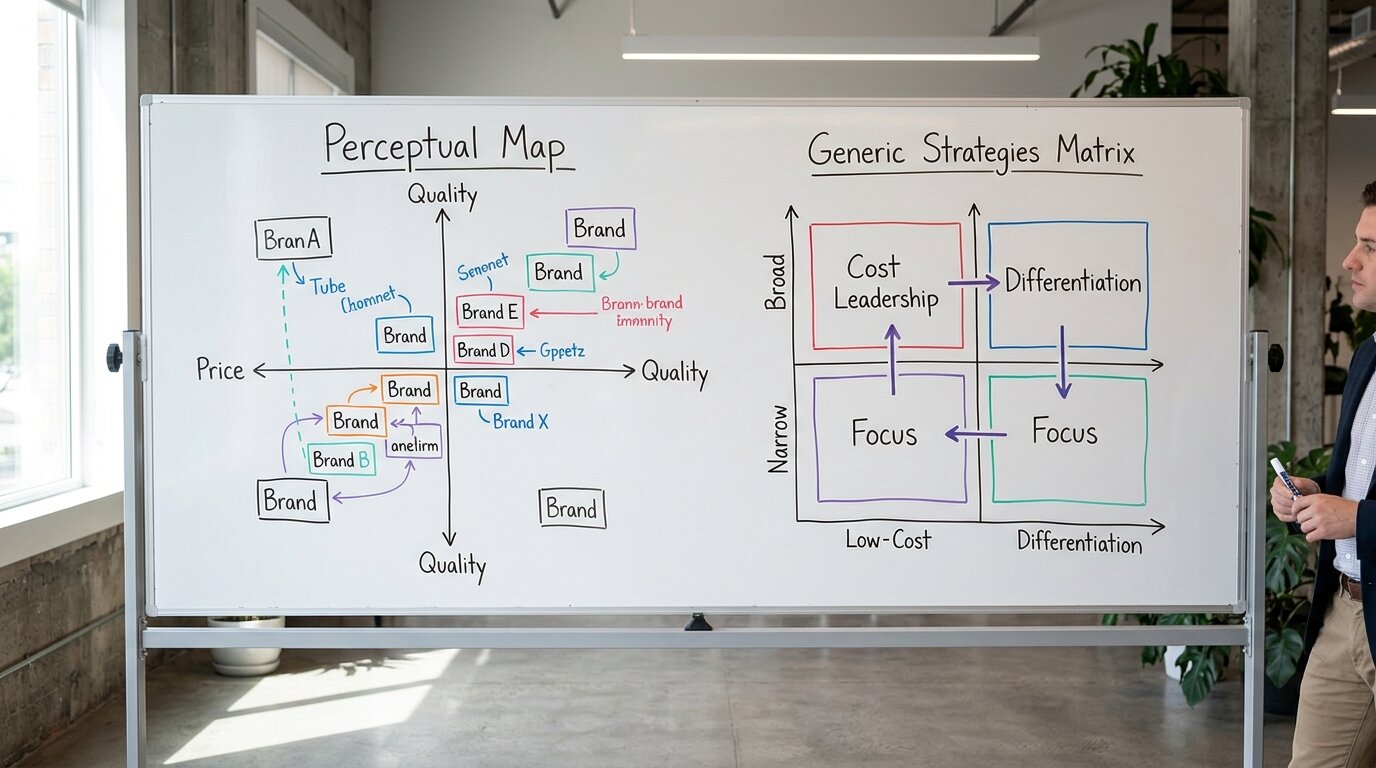
Competitive Perceptual Mapping
Competitive perceptual mapping plots your brand and your competitors on a two-axis diagram using the attributes your target customer values most when evaluating options in your category. The result is a visual picture of the competitive landscape that makes clustering and gaps immediately visible.
Where the other frameworks in this guide work from the inside out (starting with your customer or your offer), perceptual mapping works from the outside in. It starts with the competitive landscape as a whole and identifies where space exists before deciding how to claim it. This outside-in perspective is particularly useful for brands entering a crowded market or repositioning away from a saturated segment.
For a detailed walkthrough of how to build and use a positioning map, including how to choose the right axes and avoid the most common errors, the post on brand positioning maps covers the full process with a worked example.
How to Choose the Right Framework
The five frameworks above are not competing alternatives. They are complementary tools that each illuminate a different aspect of the positioning problem. Most strong positioning work uses more than one, in sequence.
| Framework | Start Here When | Primary Output |
|---|---|---|
| Positioning Statement | You need a single committed articulation of your position to align the team and brief creative work | A one-paragraph internal positioning document |
| STP | You serve or could serve multiple audience types and have not made a deliberate choice about who to prioritise | A defined primary target segment with a positioning rationale for that segment |
| Jobs to Be Done | You need to understand the deeper motivation behind why customers choose (or leave) your category | A job statement that reveals the emotional and social dimensions of the customer’s decision |
| Value Proposition Canvas | Your messaging is not converting and you need to identify the mismatch between your offer and what customers actually value | A mapped alignment between customer needs and your specific offer |
| Perceptual Mapping | You need to understand the competitive landscape visually before deciding where to position | A two-axis map showing competitor clustering and available gaps |
A recommended sequence for most growing businesses: start with STP to define the audience, use JTBD research to understand their deeper motivations, run the Value Proposition Canvas to check your offer alignment, then use the classic positioning statement to articulate the position, and validate it with a perceptual map to confirm the chosen position is genuinely available in the market.
Brand Positioning Framework Examples
The following examples use real businesses but focus on the positioning logic rather than the brand campaigns. These are not household names chosen for familiarity. They are businesses whose positioning decisions illustrate specific frameworks clearly.
For small businesses and remote teams overwhelmed by complex project tools, Basecamp is the project management platform that does less on purpose.
Their positioning is built on deliberate constraint. Every competitor was adding features. Basecamp’s differentiation was the decision to stop. The positioning statement shaped the product, the pricing, and every piece of marketing copy. The result is a brand that is genuinely divisive, which is the point.
For people who want to reduce their environmental impact without feeling like they are sacrificing pleasure, Oatly is the alternative milk that makes sustainability feel like a personality rather than a compromise.
Oatly identified that the social job (being seen as someone who cares about the planet without being preachy about it) was as important as the functional job (replacing dairy). Their positioning, tone of voice, and packaging design all address that social dimension directly.
For digitally native young adults who distrust traditional banking, Monzo is the current account that works the way your phone does.
Monzo mapped the banking sector and found a clear gap: high trust and high digital experience. Every incumbent was either trusted but slow, or fast but distrusted. Their segment targeting (younger, digital-first customers) was deliberate, not accidental. The coral card was a physical expression of the positioning.
For remote teams drowning in unnecessary meetings, Loom is the async video tool that replaces the meetings nobody wanted to attend in the first place.
Loom’s Value Proposition Canvas revealed that the customer’s biggest pain was not a lack of video tools. It was the cognitive cost and scheduling friction of synchronous communication. Their positioning addressed the pain directly, not the category. The product was positioned against meetings, not against Zoom.
Applying a Positioning Framework: The Process
A framework is only as useful as the process used to apply it. Here is the sequence that produces the most reliable positioning output.
-
Gather real customer data before touching any framework
Every framework in this guide requires honest input to produce honest output. Before any workshop or canvas-filling exercise, conduct interviews with existing customers (especially those who chose you over a named alternative), lost prospects (especially those who went with a competitor), and churned clients (especially those who left without a clear explanation). These conversations surface the language, motivations, and decision triggers that no internal team can generate on their own.
-
Map the competitive landscape independently of your preferred position
Use a perceptual map to plot where competitors actually sit before deciding where you want to be. This prevents the common mistake of choosing a position based on internal aspiration rather than market reality. A gap on the map only becomes an opportunity after you have confirmed there is genuine customer demand for what that position represents.
-
Apply your chosen primary framework with strict honesty
Select the framework most suited to your current positioning challenge and apply it with specific, evidence-backed answers. If a field in the framework cannot be filled in with something concrete and true, that blank is revealing a gap in your understanding, not in the framework. Resist the urge to fill gaps with aspirational language.
-
Stress-test the output against the competitive map
Once you have a draft position, plot it on your perceptual map. Is the position genuinely unclaimed? Is it believable given where you currently sit? Is there evidence that the target customer values what that position represents? A position that looks strong on the canvas but lands in a crowded quadrant on the map needs to be reconsidered.
-
Articulate the final position in a single statement
Regardless of which framework you used to reach the position, the final output should always be written as a classic positioning statement. This forces the commitment that frameworks like JTBD and the Value Proposition Canvas sometimes allow teams to avoid. A positioning statement cannot be vague. Either it holds together or it does not.
-
Translate positioning into brand expression
A positioning framework produces a strategic document, not a brand. Once the position is agreed on, it becomes the brief for brand identity work, messaging architecture, and every subsequent marketing decision. The framework is the foundation. The brand strategy is what gets built on it.

The Most Common Positioning Framework Mistakes
Having the right framework does not guarantee the right position. The following mistakes occur regardless of which framework is used and undermine the quality of the output at every stage.
- Using internal language instead of customer language. The words your team uses to describe your offer are rarely the words your customers use to describe their problem. Positioning built on internal language lands flat because it does not recognise the customer’s experience.
- Confusing positioning with messaging. A positioning statement is not a headline or a tagline. It is an internal strategic document. The messaging that your audience sees is derived from positioning, but it is not the positioning itself. Conflating the two produces positioning that is built around what sounds good rather than what is true.
- Claiming differentiation without proof. Every positioning claim must be supported by something verifiable. A claim of specialisation must be backed by credentials, outcomes, or a process that is demonstrably different. Claims without proof produce positioning that collapses under the first customer question.
- Building positioning for the brand you wish you were. The most honest and productive positioning work starts with where the brand actually is, not where leadership wishes it were. Aspirational positioning that cannot be supported by the current product or team misleads customers and creates internal misalignment.
- Treating positioning as a one-time deliverable. Markets change. Competitors move. Businesses evolve. A positioning framework applied once and filed away will produce a position that drifts out of relevance without anyone noticing until the symptoms become expensive to fix.
Frequently Asked Questions
A brand positioning framework is a structured methodology for defining where a brand stands in its market relative to competitors. It gives teams a repeatable process for identifying the right audience, understanding the competitive landscape, finding genuine differentiation, and articulating a position that guides every brand and marketing decision. Different frameworks approach this from different angles, and the right choice depends on your industry, your stage of growth, and the nature of your competitive challenge.
The most widely used brand positioning frameworks are the Classic Positioning Statement, the STP Framework (Segmentation, Targeting, Positioning), Jobs to Be Done, the Value Proposition Canvas, and Competitive Perceptual Mapping. Each approaches the positioning problem from a different angle. Most strong positioning work uses more than one framework in sequence.
Yes, and combining frameworks usually produces stronger positioning than relying on a single model. A common sequence is to use the STP framework to define your audience segment, Jobs to Be Done to understand their deeper motivations, and then the classic positioning statement to articulate the final output. Each framework should feed into the next rather than produce competing conclusions.
For most small and growing businesses, the classic positioning statement paired with a competitive perceptual map gives the clearest and most actionable output. The positioning statement forces a commitment to a specific audience and differentiation. The map shows where competitors sit and where the chosen position is defensible. More complex frameworks like STP or Jobs to Be Done add value as the business grows and the competitive environment becomes more complex.
A positioning framework is a tool used within a broader brand strategy process. Brand strategy covers a wider scope including brand purpose, values, personality, messaging architecture, and identity direction. Positioning is the specific strategic decision about where the brand sits in the market and in the customer’s mind. The framework is the structured methodology used to reach that decision.
Revisit your positioning framework when the business grows significantly, enters a new market, changes its core offering, or starts consistently attracting the wrong type of client. A positioning framework built for a business at one stage rarely serves it well five years later. Treating positioning as a living document rather than a one-time deliverable is one of the clearest markers of a professionally managed brand.
Need Help Choosing and Applying the Right Framework?
We run structured positioning engagements that produce a clear, defensible market position your whole team can build from.
Start the Conversation