A brand positioning map is one of the most useful tools in brand strategy, and one of the most commonly misused. When it is built correctly, it shows you exactly where your competitors are clustered, where the gaps are, and where a clear, defensible position exists for your brand. When it is built carelessly, it produces a tidy-looking diagram that confirms whatever you already believed. This guide covers how to do it properly.
What Is a Brand Positioning Map?
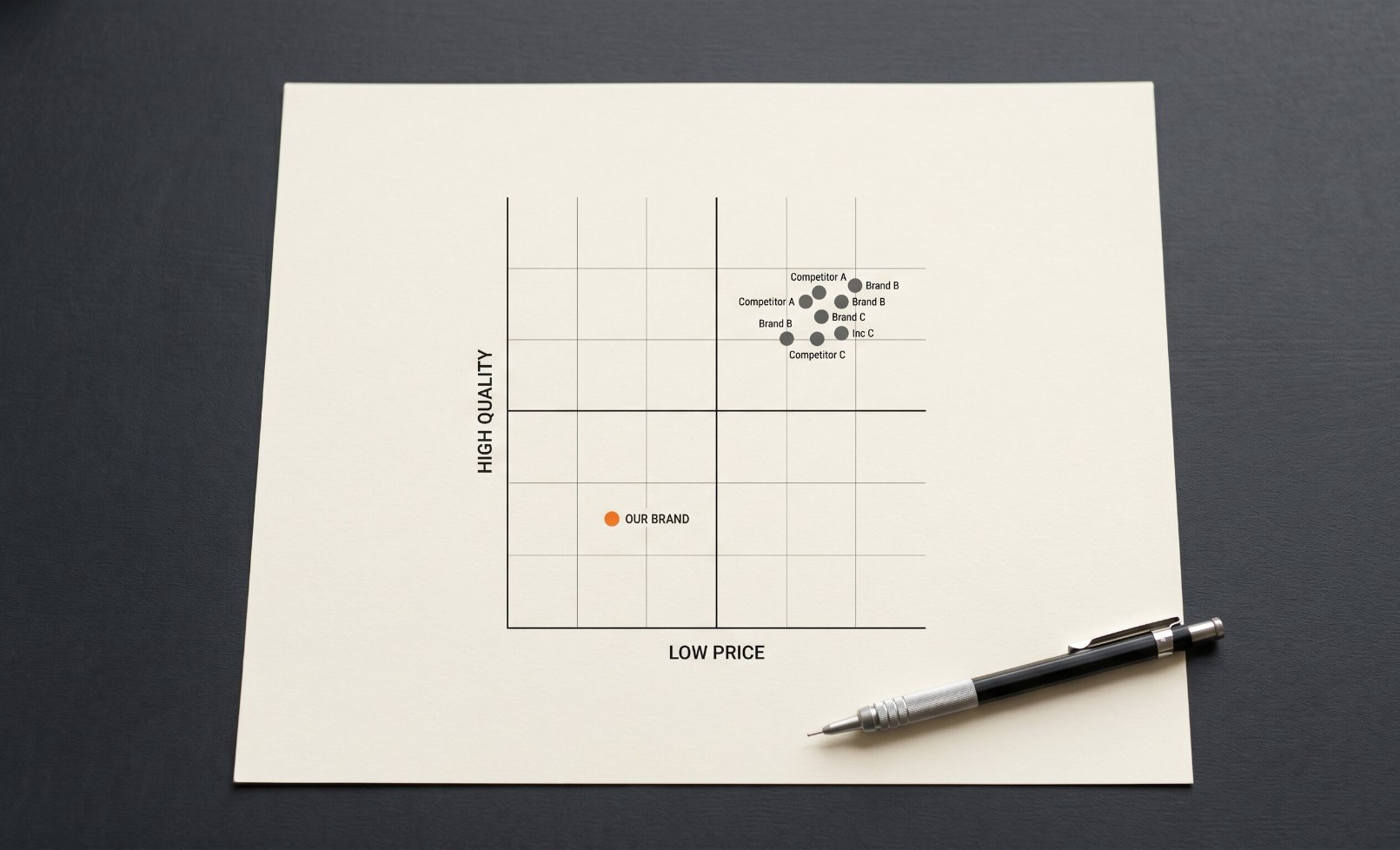
A brand positioning map (also called a perceptual map) is a two-axis diagram that plots your brand and your competitors against two attributes that your target customer uses to evaluate options in your category. The result is a visual representation of how brands are distributed across the competitive landscape.
The purpose is not aesthetic. A positioning map is a strategy tool. It makes the following visible at a glance:
- Where competitors are clustered, and therefore where the market is most saturated.
- Where there are gaps, positions that customers might value but that no current brand occupies clearly.
- Where your brand sits today relative to where you want it to be.
- Whether your intended differentiation is real or whether you are more similar to competitors than you think.
Done well, a positioning map is the clearest single output of a brand strategy process. It gives your whole team a shared picture of the competitive landscape and a clear view of the position worth owning.
An Example Brand Positioning Map
Below is an example of a positioning map for a branding agency market. The horizontal axis runs from generalist to specialist. The vertical axis runs from affordable to premium. Each dot represents a brand in the market.
In this example, most agencies cluster in the generalist and affordable zone, with a few generalist premium players. The specialist premium quadrant is largely open. That gap represents a position worth investigating. A brand that can credibly claim deep specialization at a premium price level faces far less direct competition.
A gap on a positioning map is an opportunity, but only if your target customer actually values what that position represents. The map shows where space exists. Research tells you whether the space is worth owning.
How to Choose the Right Axes
The axes are the most important decision in building a positioning map. Use the wrong axes and the map will look informative while telling you nothing useful.
The right axes represent the two attributes your target customer weighs most heavily when choosing between options in your category. Not the attributes you wish they cared about. Not the attributes that happen to make you look good. The attributes that actually drive their decision.
Some common axis pairings by category:
Specialist vs Generalist, Premium vs Affordable
Reflects the two core trade-offs clients navigate when selecting an agency or consultancy.
Premium vs Value, Traditional vs Modern
Captures the price-signal and cultural relevance dimensions most consumers use to evaluate the category.
Luxury vs Accessible, Local Character vs Global Standard
Useful for hotels and restaurants where experience type and price point shape the choice.
Simple vs Feature-Rich, SMB-Focused vs Enterprise-Focused
Reflects the two most common switching drivers in software purchasing decisions.
Institutional vs Approachable, Broad vs Niche
Captures the trust and accessibility signals that matter in this category.
Academic vs Practical, Self-Paced vs Structured
Reflects the delivery model and outcome orientation that drives enrollment decisions.
If you are unsure which axes to use, start with customer research. Ask your existing clients what they compared you against and what factors drove their decision. The answers will tell you which attributes to put on the map.

How to Build a Brand Positioning Map: Step by Step
-
Define your target audience precisely
Before you map anything, you need to know whose perception you are mapping. The competitive landscape looks different depending on who your customer is. A map built for an enterprise procurement team will use different axes and include different competitors than one built for a founder-led startup.
-
Identify every realistic competitor
List every brand your target customer would genuinely consider as an alternative to yours. Include direct competitors, indirect alternatives, and the “do nothing” option where relevant. Aim for four to eight competitors on the final map.
-
Choose your two axes
Select the two attributes that most drive your target customer’s decision. These should be attributes your customer actually uses to evaluate options, not attributes that you believe should matter or that happen to favor your brand. Validate your axis choices with customer interviews or surveys where possible.
-
Plot competitors based on evidence
Place each competitor on the map based on how your target customer actually perceives them, not how those competitors describe themselves. Use customer research, review data, pricing signals, and public messaging as your evidence base. Gut feeling alone is not sufficient.
-
Plot your own brand honestly
This is where most businesses lose objectivity. Place your brand where customers actually perceive it, not where you wish it were. If you have customer research, use it. If not, use your positioning map as a prompt to go and get it.
-
Identify and evaluate the gaps
Look for quadrants or areas of the map with no competitors or few competitors. Evaluate each gap: does it represent a position customers actually want, and can your brand credibly move toward it? A gap is only an opportunity if there is genuine demand for what that position represents.
-
Define the position you want to own
Based on the map, decide where your brand should sit. This decision feeds directly into your brand positioning statement and informs your identity work, your messaging, and your brand strategy as a whole.
Common Mistakes When Building a Positioning Map
| Mistake | Why It Happens | What to Do Instead |
|---|---|---|
| Choosing axes that favor your brand | The exercise becomes a rationalization rather than a discovery tool. | Select axes based on customer decision criteria, validated through research. |
| Placing your brand where you want it, not where it is | Honest self-assessment is uncomfortable. Optimism is easier. | Use customer feedback and external perception data to plot your brand’s actual position. |
| Using only two maps and calling it done | A single pair of axes gives you one view of the landscape. | Build multiple maps using different axis pairs to stress-test your positioning from several angles. |
| Treating a gap as automatically desirable | Empty space looks like opportunity without asking why it is empty. | Investigate whether the gap exists because customers do not value that position, or because no competitor has claimed it yet. |
| Never updating the map | The map is built once and filed away as a completed deliverable. | Review the map when competitors change, when your offering evolves, or when marketing performance starts to decline. |
How a Positioning Map Connects to Your Brand Identity
A positioning map is a strategy input, not a standalone output. Once you have identified the position your brand should occupy, that decision drives every subsequent creative choice.
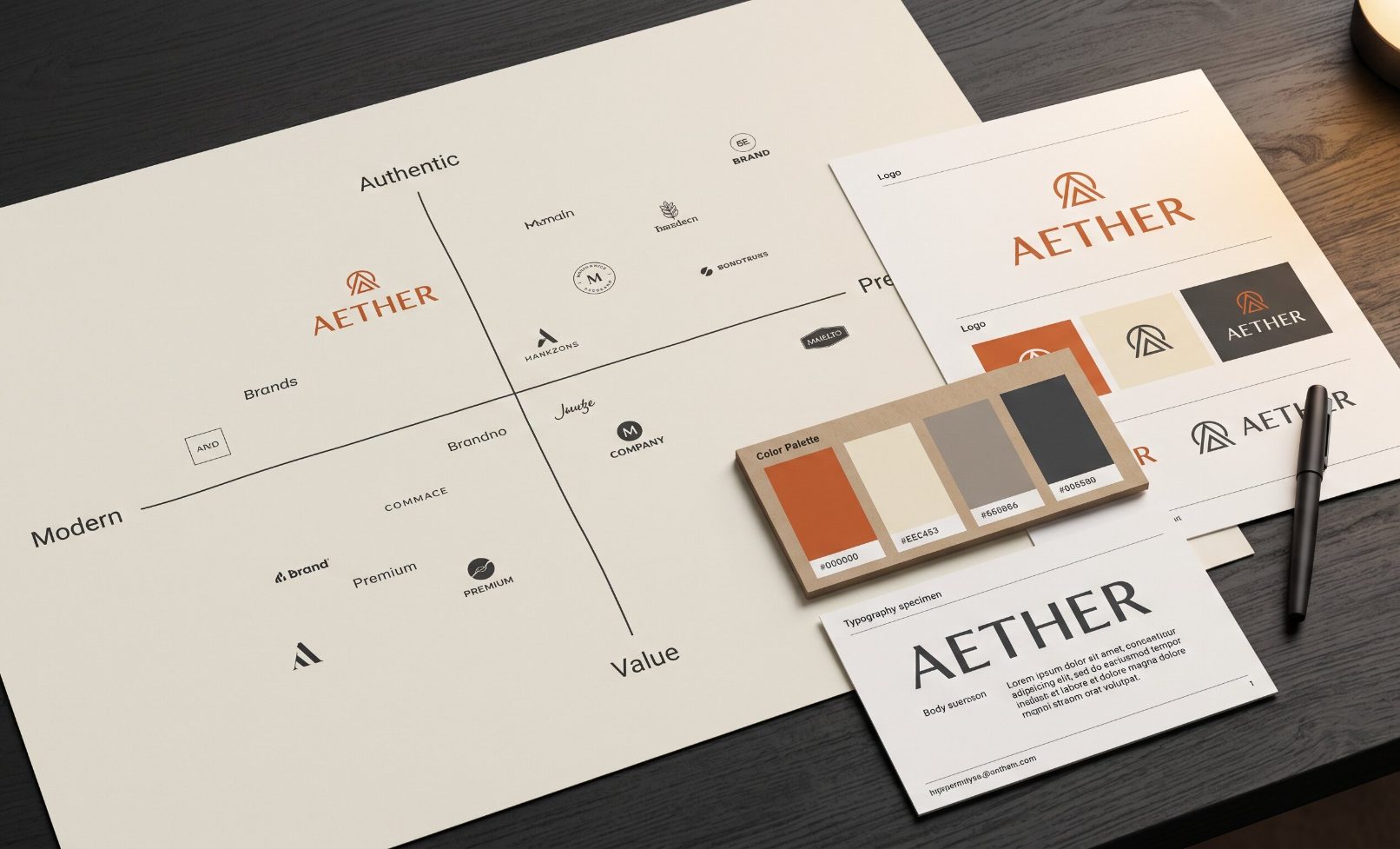
Your brand identity, the visual language, typography, color system, and tone of voice, should be a direct expression of the position you have mapped. A brand positioned in the premium specialist quadrant should look and feel noticeably different from one positioned as affordable and accessible. The map tells you what to communicate. The identity determines how.
This is why positioning work belongs before identity work. A designer briefed with a clear positioning map has everything they need to make decisions with intent. A designer briefed without one defaults to trend, personal taste, or category convention, and produces something that looks finished but says nothing specific.
When to Use Multiple Positioning Maps
One map gives you one perspective. For most brand strategy engagements, building two or three maps using different axis pairings is more useful than relying on a single view.
For example, an agency might build one map on price versus specialization, a second on digital-first versus traditional, and a third on local versus global. Each map may reveal a different competitive picture and a different gap. Comparing the three helps identify a position that is both distinctive and consistently available across multiple dimensions of the market.
If your brand shows up in an uncrowded zone on every map you build, you have found something real. If you only appear distinctive on one axis, your position may be more fragile than it looks.
Frequently Asked Questions
A brand positioning map is a two-axis visual diagram that plots your brand and your competitors against two attributes that matter to your target customer. It makes competitive gaps visible, shows where the market is overcrowded, and helps identify a position worth owning. It is a strategy tool, not a design deliverable.
The axes should represent the two attributes your target customer uses most to evaluate options in your category. Common pairings include price versus quality, specialist versus generalist, traditional versus modern, and product-led versus service-led. The right axes depend entirely on your category and your audience. Generic axes produce generic insights.
The terms are often used interchangeably, but there is a useful distinction. A perceptual map reflects how customers currently perceive brands in the market, based on research. A positioning map can also include where a brand wants to move, or where an untapped position exists. Perceptual maps describe reality. Positioning maps inform strategy.
Include every realistic alternative your target customer would consider, typically between four and eight. More than ten makes the map difficult to read and dilutes the insight. Focus on direct competitors in your specific category rather than every player in a broad industry.
Yes, and it is often more useful for smaller businesses than for large ones. A small business with limited marketing resources cannot afford to compete broadly. A positioning map helps identify the specific gap where a smaller brand can own a clear, defensible position without going head-to-head against larger, better-resourced competitors.
Revisit your positioning map whenever a significant competitor enters or exits the market, when your own offering changes substantially, or when you start seeing signs that your current position is losing relevance. For most growing businesses, an annual review is a sensible minimum.
Want to See Where Your Brand Actually Stands?
We map your competitive landscape, identify the gaps, and build a position your brand can own and defend.
Start the Conversation